
Matsangoni Agroforestry Project
GOAL
To improve the household income and health of 3,300 smallholder farmers and their families by intercropping cashew trees with finger millet.

LOCATION
Matsangoni Ward of Kilifi County in Kenya

DURATION-
2022
-
2025

FARMERS
3,300

VALUE CHAINS
Cashew, Finger Millet


FUNDING
GBP 150,000
Matsangoni Agroforestry Project
EFF has been working for several years with a group of 3,500 households in Matsangoni Ward of Kilifi County, Kenya. Initially using cashew as a gateway, our work within this community has grown to encompass initiatives that span agroforestry; food security and nutrition; farmer organisation and market access; soil and water conservation; and youth entrepreneurship. This is because we realised that any approach to transforming livelihoods requires synchronicity in multiple domains.
Household Income
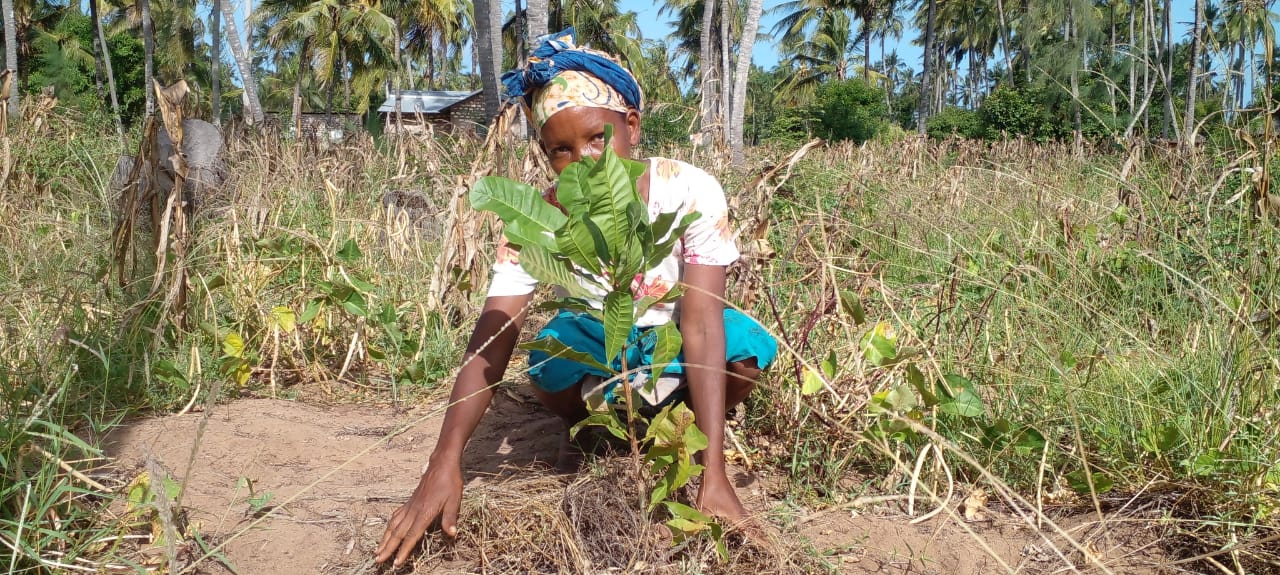
With the support of the Agriculture and Food Authority of Kenya, EFF propagated and planted over 130,000 high-yield variety Tanzanian polyclonal seedlings across the ward (spanning 92 km sq) on the farms of 3,300 households between 2022-2024. The aim is to have 100,000 mature and flourishing cashew trees and EFF’s extension staff work continuously with lead farmers and their farmer groups over the course of the 3 year project to ensure maximum survival rate of the trees, despite erratic rains, lack or irrigation, exceptionally hot dry seasons, and common pests & diseases.
Household Nutrition
Together with cashew for household income, the project sponsored by the innocent foundation UK spearheaded the reintroduction of finger millet, an indigenous, drought resistant and highly nutritious staple that had gone out of fashion in favour of maize, which requires more water and is less healthy. Kilifi County has a high rate of malnutrition, especially amongst young women and young children. Through a ward-wide sensitisation campaign targeting primary health care centres and their volunteers, traditional leadership, school learning programs and mass media, target audiences were informed on the health benefits of finger millet. Each year (2023, 2024 and 2025) a cohort of 1,100 farmers are provided GAP training in finger millet cultivation and post-harvest methodologies along with certified seeds to plant on a quarter acre each. This translates to roughly 2-3 bags of 90kg each, enough for the young mothers and young children in the household to consume for the whole year.
Sustainable Systems
EFF supported the establishment of the Mibibo Cashew Farmer Cooperative in 2022. To date, the cooperative has about 250 registered members. Through exposure to the county cooperative department, training programmes such as the Emerging Leaders, informative sessions from other Kenyan cooperatives, and extensive training in financial planning, the Mibibo leadership has been able to develop a 5-year business plan. In 2023, Mibibo secured their first official offtake agreement with Nuts n More, a state-of-the-art cashew processing factory located in Kilifi County that exports most of its kernels to Europe. This is the beginning of a longstanding partnership that has already yielded new partners and potential opportunities for organic certification and fair trade.
Climate Resilience
Kilifi County is drought-prone. To ensure the survival of the cashew trees that are planted, EFF’s farmers are equipped with know-how on water conservation techniques and soil fertility improvement (including organic manure and vermicomposting). In addition the Foundation has sponsored the construction of 5 farm ponds to harvest rainwater and which supply between 30-34 nearby households for their farming needs. To meet a double objective of tree pollination and create employment opportunities, EFF also provided seed capital for the Chumatsaro Youth Group to set up 10 beehives for honey production. The hives are located on the edges of the Araboku Sokoke coastal rainforest.
Matsangoni Cashew Tree Improvement Pilot Project
In late 2020, EFF held a landmark workshop in Kwale County along the coast of Kenya. This brought together stakeholders from the Ministry of Agriculture, administrative representatives from all the 6 coastal counties, NGOs, financiers, agro-dealers, and farmers. The question that was discussed over two days was the reasons behind the decline of Kenya’s cashew industry, and potential solutions for its revival. The result of this was the endorsement of EFF’s long-term strategic involvement along the Coast to attempt to bring back glory to Kenya’s cashew sector.
To kickstart, the Foundation designed and implemented a pilot aimed at evaluating the health status of the existing cashew trees, which number approximately 2 million as per the last census conducted in 2009. From May to November 2021, EFF conducted a baseline and onboarded 1,500 farming households in Matsangoni ward. Just over 50,000 older and largely unproductive cashew trees received targeted interventions that included regimens of administering fertilisers and agro-chemicals to tackle prevalent pests and diseases, About 25 youth from Matsangoni were trained in these interventions and provided the necessary equipment.
The results were remarkable: the targeted trees demonstrated a 25% improvement in productivity and overall nut quality. However, from the current low yields of cashew, it was also concluded that farmers could not always generate enough cash to afford the inputs and services required to look after their older trees. The decision was made to pivot to investing in new plantations and bringing in high yield variety seedlings from Tanzania, whose cashew is a globally prized commodity.